

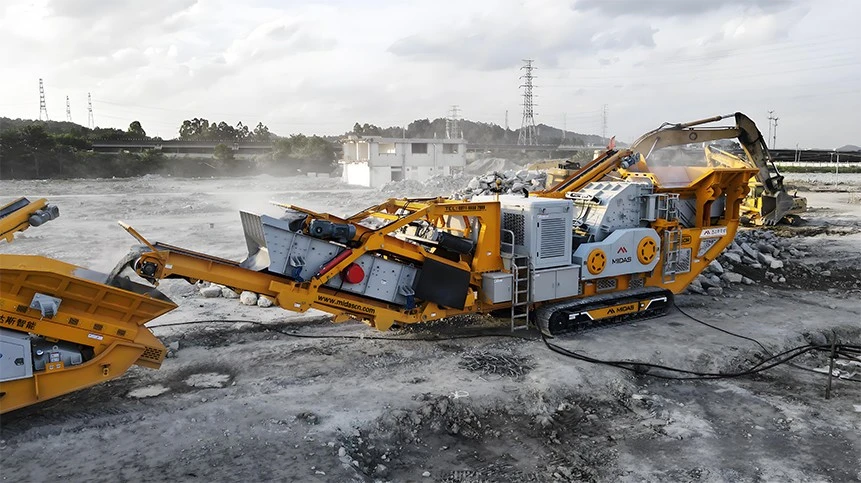
The price of mobile crushers is influenced by multiple factors, with the core lying in the dynamic balance of equipment performance, configuration costs, and market supply-demand. The key pricing factors are analyzed from the dimensions of technical parameters, configuration selection, supply chain costs, etc. as follows:
Core Technical Parameters and Performance Configuration
Type differences:
Jaw-type mobile crushers (mainly for coarse crushing): The price is relatively low (200,000 - 20,000,000 RMB), suitable for primary crushing of high-hardness materials;
Cone-type mobile crushers (special for medium crushing / hard rocks): The price is at a medium level (800,000 - 50,000,000 RMB), with high costs due to the laminated crushing structure;
Impact / impact-type mobile crushers (medium crushing / sand making): The price range is wide (500,000 - 60,000,000 RMB), and high-end models (such as VSI sand making machines) include patented technologies for wear-resistant parts.
Model parameters:
Feeding inlet size (e.g., jaw crusher CJ96 with feeding inlet 930×660mm vs. CJ612 with feeding inlet 1200×900mm). For each increase in the gear, the price increases by 20%-30%;
Processing capacity (100t/h vs. 800t/h). For each increase in the order of magnitude, the cost increases by 50%-100%.
Chassis types:
Tire-type: Lower price (300,000 - 30,000,000 RMB), suitable for road transfer but with limited site adaptability;
Crawler-type: 30%-50% higher price (800,000 - 80,000,000 RMB), equipped with hydraulic drive systems and intelligent steering devices, adapted to complex terrains such as mountains or wetlands.
Power system:
Diesel drive (standard configuration): The cost is fixed, and fuel consumption design needs to be considered (e.g., engine power 160kW vs 315kW, price difference of 500,000-1,000,000 RMB);
Hybrid oil-electricity/full electricity (high-end configuration): The price increases by 20%-40%, but the long-term energy consumption cost is reduced by more than 30%, which is suitable for scenarios with high environmental protection requirements.

Functional Modules and Additional Configurations
Number of screening layers:
Single-layer screen (price increases by 50,000-150,000 RMB) vs. three-layer screen (increases by 200,000-500,000 RMB). Screening efficiency is directly proportional to costs.
Impurity removal devices:
Electromagnetic iron remover (price: 50,000-200,000 RMB): Used to eliminate metal impurities and protect the crushing chamber.
Light material separator (100,000-300,000 RMB): Suitable for construction waste scenarios to separate impurities such as plastics and wood.
IoT monitoring system: Basic version (including current/vibration monitoring, price increase of 80,000-200,000 RMB) vs. advanced version (AI predictive maintenance + remote control, price increase of 500,000-1,200,000 RMB);
Automatic lubrication system: Hydraulic automatic lubrication (price increase of 100,000-250,000 RMB) vs. manual lubrication (standard configuration), with a 30% annual difference in maintenance costs.
Supply Chain and Manufacturing Costs
Proportion of imported components:
Bearings (Swedish SKF/German FAG vs domestic Luoyang LYC): The cost difference per set is 20,000-80,000 RMB, and the price of the complete machine differs by 5%-15%;
Hydraulic systems (German Rexroth vs domestic Huade): The cost difference is 100,000-300,000 RMB, affecting equipment stability and service life.
Wear-resistant part materials:
High-manganese steel liners (moderate price, service life of 500-800 hours) vs. high-chromium cast iron (30% higher cost, service life of 1,200-1,500 hours), directly affecting users'后期 (post-operation) maintenance costs.
Processing accuracy:
The moving jaw assembly uses a CNC machining center (accuracy ±0.02mm) vs. ordinary machine tools (±0.1mm), increasing manufacturing costs by 15%-25%, but reducing equipment operation noise by 10dB and failure rate by 40%;
Brand influence:
International brands (such as Metso, Terex) are 50%-100% more expensive than domestic similar products, with premiums derived from technical patents and global service networks;
Domestic leading brands (such as Sany, XCMG) have a premium of 20%-40%, relying on large-scale production to reduce marginal costs.
Market Supply and Demand, and Project Customization Requirements
During the peak season of infrastructure investment (such as the issuance period of government special bonds): When equipment is in short supply, prices increase by 5%-10%;
During periods of tightened environmental policies: The demand for electric/low-energy consumption models surges, with a premium of up to 15%-20%.
Adaptation to special scenarios:
Explosion-proof mobile crushers (for coal mine crushing): Require installation of explosion-proof motors and static elimination devices, with a price increase of 300,000-800,000 RMB;
Customization for low-temperature environments (below -30℃): Use low-temperature resistant hydraulic oil and heating systems, with a cost increase of 200,000-500,000 RMB.
Production capacity ramp-up services:
Requirements for completing installation and debugging within 48 hours (常规 72 hours): Urgent fees of 50,000-150,000 RMB need to be paid, involving priority adjustment of logistics and technical teams.
Price Range Reference (Domestic Mainstream Models)
|
Device Type |
Processing capacity (t/h) |
Chassis form |
Price range (10000 yuan) |
Typical application scenarios |
|
Tire type jaw broken mobile station |
50-300 |
Wheel |
30-150 |
Small scale mine rough breaking |
|
Tracked cone-shaped mobile station |
200-800 |
Crawler-type |
150-600 |
Crushing in large mining sites |
|
Tire type counterattack mobile station |
100-600 |
Wheel |
60-300 |
Construction waste disposal |
|
Crawler type sand making mobile station |
80-300 |
Crawler-type |
120-500 |
Production of high-quality machine-made sand |
Purchase Recommendations
Clarify core requirements: first define material hardness (Mohs hardness level 3-7), production capacity (daily output/annual turnover), and site liquidity requirements;
Pay attention to the full lifecycle cost: the initial procurement cost accounts for about 60%, and the later maintenance (replacement of wear-resistant parts, fuel consumption) accounts for 40%. Priority should be given to selecting models with universal design for vulnerable parts;
Supplier comprehensive capability: Evaluate the response time of after-sales service (such as 4-hour on-site arrival), the inventory rate of accessories (commonly used parts ≥ 95%), and avoid downtime losses.
By dismantling the above factors, the price rationality of mobile crushers can be more accurately evaluated, balancing performance requirements and budget control.
If you have any purchasing questions, you can contact us. China Yonghua Machinery has been focusing on the research and production of mobile crushers, crushing equipment, and sand making equipment for more than 20 years. We will create exclusive solutions and the most cost-effective product combination according to your needs


