


Frequently Asked Questions
Q: Possible faults and elimination methods of the impact crusher:
A: 1. Phenomenon: Sudden increase in vibration amplitude Cause: When the blow bars are replaced or assembled, the rotor is not well balanced. Elimination method: Reinstall the blow bars and perform a balance correction on the rotor.
2. Phenomenon: Excessively large discharge size Cause: Excessive wear of the liners and blow bars leads to an overly large gap. Elimination method: Adjust the gap between the front and rear impact frames, or replace the liners or blow bars.
3. Phenomenon: Knocking sound inside the machine Cause 1: Uncrushable materials enter the machine. Elimination method: Clean the crushing chamber after stopping the machine. Cause 2: The fasteners of the liners are loose, and the blow bars hit the liners. Elimination method: Check the fastening condition of the liners and the gap between the blow bars and the liners. Cause 3: The blow bars or other parts are broken. Elimination method: Replace them.
4. Phenomenon: Excessively high bearing temperature Cause 1: Too much or too little grease. Elimination method: Check if the amount of grease is appropriate. Cause 2: The grease is too dirty. Elimination method: Clean the bearings and then replace the grease. Cause 3: The bearings are damaged. Elimination method: Replace them.
Q: Pay Attention to These 6 Points in the Daily Maintenance of the Cone Crusher
A: The cone crusher is widely used in industrial production due to its many advantages, such as a large crushing ratio, high efficiency, low energy consumption, and uniform product particle size. In actual production, there are various factors affecting the working performance of the cone crusher. Some are related to the design structure, and some are caused by unreasonable operations during the usage process. This article shares several key points that need to be inspected in the daily maintenance of the cone crusher, as well as the treatment methods when malfunctions occur.

1. Inspection and Solution of the Clearance between the Main Shaft and the Taper Sleeve During the daily inspection of the clearance between the taper sleeve and the main shaft, only the clearance at the upper opening is detected. That is, a section of fuse wire of moderate thickness is placed on the upper opening of the thin-edge and thick-edge taper sleeves respectively. Hoist the cone body and the main shaft into the tapered hole, and the spherical surface of the cone body should be compacted on the bowl-shaped bearing liner. Then hoist out the cone body and measure the thickness of the two fuse wires. The measured value is the actual clearance between the upper opening of the taper sleeve and the main shaft. The adjustment of the clearance between the main shaft and the taper sleeve can be achieved by changing the thickness of the shim plates at the contact surface between the bowl-shaped bearing seat and the frame. When measuring the tooth clearance of the large and small bevel gears, the heavy side of the eccentric sleeve should be on the side of the small gear.
2. Inspection and Solution of the Contact Condition on the Thin-edge Side between the Taper Sleeve and the Main Shaft When the contact range on the thin-edge side between the taper sleeve and the main shaft is less than one-fourth of the height of the taper sleeve, or the number of contact points within an area of 50mm×50mm is less than one, a triangular scraper or an angle grinder should be used to scrape and grind the high points of the inner hole. At the same time, a steel ruler should be used to detect the busbar of the inner hole at the grinding position. It is required that the visually measured clearance is zero and the rough grinding meets the requirements. Then apply the grinding compound at the contact surface, install the cone body and let it idle for 10 minutes, then hoist it out for inspection and grinding, and repeat the operation until the contact range is more than one-fourth of the height of the taper sleeve and it contacts evenly with the main shaft, and the number of contact points within an area of 50mm×50mm is more than one. When there is a crack with a length less than 200mm at the upper opening of the taper sleeve and along the direction of the busbar, and it does not affect the contact and clearance between the taper sleeve and the main shaft, a crack arrest hole with a diameter of 8-10mm can be drilled at the lower end of the crack and then it can be used continuously. When the thin-edge side of the eccentric bushing bulges inward due to heat, use a grinder to grind the inner hole and use the edge of a steel ruler to detect along the direction of the busbar of the tapered hole. Insert the taper sleeve into the tapered hole and run it, and grind and inspect repeatedly according to the fitting condition. The clearance between the taper sleeve and the hole of the eccentric sleeve should be less than 0.1mm.
3. Inspection and Solution of the Contact Amount between the Spherical Surface of the Moving Cone and the Bowl-shaped Bearing Liner After evenly applying the grinding compound on the spherical surface of the moving cone, grind the moving cone body and the bowl-shaped bearing liner against each other so that the contact points are evenly distributed within the ring of 1/3-1/2 of the radius of the bowl-shaped bearing liner. The wedge-shaped clearance of the inner circumference should be maintained between 0.5-1mm, and there should be no less than one contact point within an area of 25mm×25mm, and there are no contact points within the inner circle of 1/2 of the radius on the other side. In addition, when the wear amount of the bowl-shaped bearing is large, the cone body drops significantly and the spherical surface of the moving cone cannot contact the inner circle of the bowl-shaped bearing liner. The bowl-shaped bearing liner should be updated in time.
4. Solution to the Wear of the Disk of the Eccentric Bushing When the wear amount of the disk on the eccentric bushing is large, the repair method of surfacing first and then turning can be adopted; when the wear amount is small, holes can be drilled on the other side of the disk, and it can be used continuously after turning it over.
5. Set up an Automatic Lubrication Monitoring System The lubrication system should be electrically interlocked with the main motor and the supporting feeder to ensure that all transmission parts can be fully lubricated during the operation of the crusher. Only after the oil pump is started can the main motor start to run. When the oil pump stops or the oil pressure is lower than 0.05MPa and the temperature is higher than 55℃, the control system will send a signal, and the main motor and the feeder will stop running to ensure that the transmission parts are not damaged. The selection of the machine oil can refer to the change of the climate. Generally, 40# machine oil can be used at normal temperature, 50# machine oil is selected in summer, and 20# or 30# machine oil is selected in winter.
6. Replace the Copper Bushing with a Nylon Bushing Nylon bushings are widely used to replace traditional copper bushings due to their advantages such as light weight, low cost, wear resistance, and fatigue resistance. Similarly, nylon bushings can also be used to replace copper bushings in cone crushers. When the thin-wall side of the eccentric bushing bulges inward, the nylon bushing can compensate for this defect through plastic deformation.
Moreover, when the nylon bushing and the main shaft are in adhesive wear, its strength is lower than that of the copper bushing, so the probability of causing "runaway" is much lower. However, when using a nylon bushing to replace a copper bushing, the interference fit amount of the assembly should be slightly larger, and a corresponding cooling system should be selected at the same time. Various faults may occur during the production of the cone crusher. The staff must operate in strict accordance with the operation and maintenance regulations of the equipment to effectively improve the performance of the equipment and safeguard the interests of the enterprise.
Q: The common faults of the jaw-type mobile crusher during its operation and the corresponding solutions mainly include the following aspects
A:I. Intense splitting sound and the moving jaw not moving:
Fault cause: The tie rod is broken, the tension spring is broken, materials that cannot be crushed enter the crushing cavity, or the toggle plate falls off or breaks.
Solution: Replace the tie rod and the tension spring, and check and deal with the foreign objects in the crushing cavity.
II. Blockage of the crushing cavity:
Fault cause: Large stones remain at the top of the crushing cavity, there is a fault with the belt conveyor at the bottom of the discharge port, sticky materials enter or sundries block the discharge port, and the feeding amount is too large.
Solution: After stopping the machine, tie the large stones with a steel wire rope and lift them out with a crane. Eliminate the fault of the belt conveyor, unclog the discharge port, slow down the rotation speed of the feeder, and reduce the feeding amount.
III. The movable jaw plate and fixed jaw plate vibrate and produce impact sounds:
Fault Cause: The jaw plate fastening bolts are loose or missing, or the fixed bolts of the crushing plates are broken.
Solution: Tighten and replace all missing crushing plate bolts, replace damaged bolts, and adjust the discharge opening to ensure the correct gap between the two jaw plates.
IV. Blockage of the discharge port, failure or breakage of the adjusting device:
Fault cause: The horizontal forward movement distance of the wedge-shaped top seat is too large, the toggle plate and the toggle plate pad do not meet the design requirements, the fixing bolts of the adjusting seat are loose or fall off, and the adjusting seat has processing technology defects.
Solution: Pull the wedge-shaped top seat backward, replace the adjusting seat and assemble the original toggle plate and toggle plate pad, tighten or replace the bolts of the adjusting seat, and replace the defective adjusting seat.
V. Fracture of the moving jaw:
Fault cause: Bearing an excessive load, having process defects such as dense air holes during the casting process, and using unqualified toggle plates or toggle plate pads.
Solution: Check and replace unqualified components, and ensure that the equipment operates under normal load.
VI. The liner falls off from the liner seat:
Fault cause: The fed material is too large, the tension spring is too loose, and the material is directly fed onto the upper moving jaw cover.
Solution: Feed materials of appropriate size, tension the tension spring, and ensure that the materials enter the crushing cavity instead of impacting the upper moving jaw body cover.
VII. The liner cracks (or bends):
Fault cause: The tension spring is too loose, the fed material is too fine, miscellaneous iron or uncrushable materials are stuck at the bottom of the crushing cavity, and the toggle plate is installed incorrectly.
Solution: Tension the tension spring, feed materials of appropriate size, empty the crushing cavity, remove the miscellaneous iron or uncrushable materials, and check and install the toggle plate correctly.
VIII. The bolts of the feeding hopper are loose or damaged:
Fault cause: The material level in the crushing cavity is too high, and Loctite is not applied to the bolts of the feeding hopper.
Solution: Maintain the correct particle size of the fed material, ensuring that the material occupies two-thirds of the volume of the crushing cavity, and apply Loctite to prevent the bolts from loosening.
IX. Insufficient crushing capacity:
Fault cause: The feed particle size is too large, the rotation direction of the flywheel is wrong, the speed is inappropriate, the discharge opening is too small, the jaw plates are excessively worn, and the jaw plates are loose.
Solution: Check the correct feed particle size, check and correct the rotation direction of the flywheel, adjust the speed, enlarge the discharge opening, replace the worn jaw plates, and tighten the bolts of the jaw plates.
Q: How to replace the liner plate of a jaw crusher?
A: Jaw crushers are highly favored and loved in sand and gravel plants due to their advantages of simplicity, sturdiness, wear resistance, and easy maintenance. However, because they frequently crush large pieces of stone, the wear-resistant components are prone to damage during operation. The liner plates, thrust plates, and eccentric shafts are the main wear-resistant components. Today, let's learn how to replace the liner plates of jaw crushers. The specific introduction is as follows:
Ⅰ. Role of the Liner Plate in a Jaw Crusher
The liner plate of a jaw crusher is one of the main vulnerable components, primarily used to protect the crusher's crushing chamber from wear or damage. Once it is damaged, it needs to be replaced promptly; otherwise, it will affect the crushing efficiency and service life of the equipment.
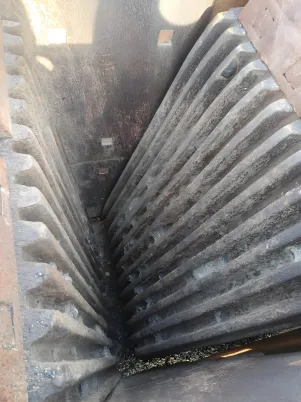
II.Preparation Work
1. Shutdown and Inspection: Before replacing the liner plate of the jaw crusher, first shut down the equipment and check all its indicators to ensure the equipment was operating normally. Power and gas supplies should be cut off to ensure personnel safety.
2. Tool Preparation: Check whether maintenance tools and required consumables (new plates and screws) are complete.
III. Removal of Old Liner Plate
1. Open the Crusher: Stop the machine and clean it, then open the front cover of the jaw crusher.
2. Remove the Old Plate: Loosen the screws of the liner plate to be replaced, remove the old plate, and take out the residual screws in the old plate.
3. Cleaning and Inspection: Thoroughly clean the crushing chamber and check for any other damages that need repair.
IV. Installation of New Liner Plate
1. Install the New Plate: Align the new liner plate of the jaw crusher with the screw holes, place it into position, and tighten the screws (pay attention to the direction and length during installation) to ensure the plate fits tightly against the surface of the crushing chamber.
2. Tighten the Screws: Tighten the screws on the new plate, taking care not to overtighten or undertighten them.
3. Inspection and Test Run: After the replacement, conduct a thorough inspection of the equipment, followed by a small-scale production test run to ensure the newly installed liner plate operates normally and achieves the expected results.
Q: How to Choose Between Impact Crushers and Cone Crushers?
A: Application Scenarios and Material Characteristics
Impact Crushers:
Suitable for medium and fine crushing operations, particularly for processing materials with medium to low hardness, such as limestone and coal gangue. They produce finished products with good shape but higher content of flaky and needle-shaped particles, making them suitable for producing general construction sand and gravel.
Cone Crushers:
Suitable for medium and fine crushing operations, especially for processing high-hardness materials like granite and basalt. Their finished products have uniform particle sizes and low flaky/needle-shaped particle content, making them ideal for producing high-quality sand and gravel aggregates.
Crushing Principles and Structural Characteristics
Impact Crushers:
Utilize the principle of impact crushing, where materials are repeatedly impacted and crushed between the hammer plates and impact plates. They feature a simple structure and lower maintenance costs, but the hammer plates wear out relatively quickly and require regular replacement.
Cone Crushers:
Employ the principle of laminating crushing, crushing materials through the extrusion and grinding action between the moving cone and fixed cone. Their structure is complex and maintenance is more challenging, but wear-resistant components have a longer replacement cycle, resulting in higher single maintenance costs.
Cost-effectiveness and Return on Investment
Impact Crushers:
The equipment has a lower investment cost, making it suitable for enterprises with limited budgets. Although the initial investment is small, the later maintenance costs are relatively high.
Cone Crushers:
The equipment has a higher price and is suitable for enterprises with sufficient budgets. Although the initial investment is large, the long-term operation cost is low, making it suitable for large-scale production.

Q: How to select appropriate crushing equipment according to the types of ore
A: I. Different Types of Ores and Their Characteristics
High-hardness Ores: Such as quartzite, basalt, and granitic rock, these ores have high hardness, fine texture, and strong toughness. Suitable for USE JAW crusher because of its strong crushing capacity, especially suitable for processing ore with compressive strength not exceeding 320MPa.
Low-hardness friable ores: Such as shale, chalk, gypsum, etc., these ores have low hardness and are fragile. Impact crushers or cone crushers are suitable, as these devices are specially designed for processing low-hardness ores and can efficiently complete the crushing task.
Youdaoplaceholder0 Medium-hard ores:such as limestone, calcite, etc., are suitable for use with cone crushers and roller crushers, which are suitable for medium and fine crushing operations of medium-hard materials .
Youdaoplaceholder0 Fragile materials:such as kaolinite and pyrite, are suitable for impact crushers and hammer crushers, which are small in size, simple in structure, have a large processing capacity and low energy consumption .
II. Application Scenarios, Advantages and Disadvantages of Different Crushing Equipment
Jaw Crusher: Suitable for coarse crushing operations to process large pieces of ore. It has a simple structure and is easy to maintain, but generates relatively loud noise.
Cone Crusher: Suitable for medium and fine crushing operations to process medium-hardness ores. It has a complex structure but high production efficiency, making it suitable for long-term operation.
Hammer Crusher: Suitable for processing low-hardness and brittle materials. It is small in size, has a large processing capacity, and low energy consumption, but is prone to wear and generates significant noise.
Impact Crusher: Suitable for processing medium-hardness materials. It has a simple structure and is easy to maintain, but is prone to wear.
III. Specific Steps and Recommendations for Selecting Crushing Equipment
Determine Ore Characteristics: Select appropriate crushing equipment based on physical properties of the ore such as hardness and brittleness. For high-hardness ores, choose jaw crushers; for low-hardness and friable ores, opt for hammer crushers, roll crushers, or impact crushers.
Consider Production Requirements: Select suitable equipment according to production capacity, processing volume, and crushing particle size requirements. Use jaw crushers for coarse crushing, cone crushers for medium crushing, and hammer or impact crushers for fine crushing.
Technical and Economic Comparison: Conduct technical and economic comparisons from aspects such as equipment installation power, weight, capital construction investment, and production and operation management costs, and select the optimal option.